
Carbon fiber delamination: what it is, what it looks like, and why a clean paint surface guarantees nothing
Delamination is the central failure mode in carbon bicycle frames, and most of it is invisible from outside. A reference on the physics of ply separation, the surface signatures that hint at subsurface damage, and how visual triage and NDT slot together to confirm it.
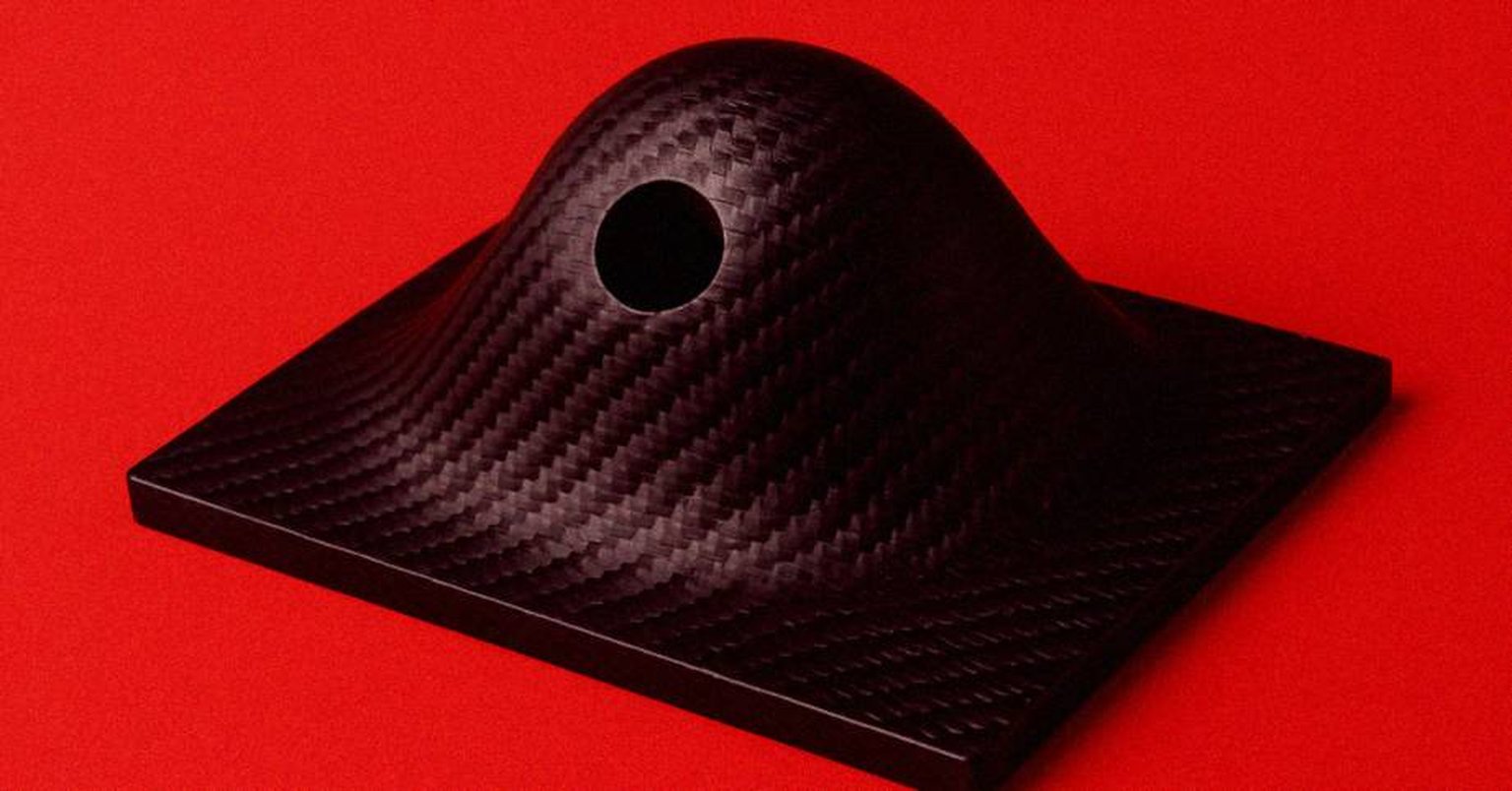
Carbon fiber delamination is the separation of adjacent plies inside a CFRP laminate. Once it has formed, the layers can no longer share load through the thickness of the wall, and buckling and compressive strength fall sharply. The diagnostic hazard is that delamination is frequently invisible from outside, betrayed only by a localized paint crack, a subtle finish bubble, a faint white halo around an impact point, or a soft response under thumb pressure (Carbon Bike Doctor). The single most useful idea to carry through the rest of this reference is that on a carbon frame, the severity of a defect is often inversely related to how dramatic it looks. A faint scuff can sit over a shattered laminate, and a frightening web of cracks can be confined entirely to the paint.
This is the cluster's reference page on delamination as the central failure mode in carbon bicycle frames. It covers the physics of ply separation, the surface signatures that hint at subsurface damage, the modes (barely visible impact damage, clamp crushing, impact halo) that produce delamination most often, why field methods including the coin-tap test cannot resolve it reliably, and how visual triage and NDT slot together to confirm it.
Why delamination is the central problem#
Carbon fiber reinforced polymer is anisotropic and heterogeneous. Strength comes from stiff PAN-based carbon filaments, typically Toray T700, T800, T1000, or T1100 grade, embedded in a brittle thermoset epoxy matrix (Mondince Cycle). The fibers carry tensile and compressive load along their length. The matrix transfers shear between plies and shields the fibers from the environment. As long as the fiber-matrix interface is sound, external loads distribute across the whole laminate.
Two consequences follow. The fiber-matrix interface governs everything: when adjacent plies decouple, the laminate stops behaving as a unit. Thin walls are exceptionally vulnerable to out-of-plane forces, because the same high-modulus fibers that let engineers build tube walls down to roughly 0.8 mm have their axial strength oriented in the direction the load mostly travels, leaving the through-thickness response governed by the much weaker matrix and the interlaminar bond.
Carbon also does not deform plastically. It does not dent and warn the way ductile steel or aluminum does. It accumulates hidden internal damage and then, past a threshold, fails suddenly. That combination, invisible damage plus sudden failure, is what makes delamination structurally and practically different from the failure modes on a metal frame.
How delamination forms#
Three mechanisms dominate.
Low-velocity impact. A rock kicked up by a passing car, a fall onto a top tube, a dropped frame in a workshop, a tool strike. The aerospace literature calls this barely visible impact damage, or BVID. The kinetic energy passes through the laminate thickness, generating high interlaminar shear and bending stresses. The damage propagates in a pine-tree or conical (frustum) distribution, widening as it goes deeper, with the worst delamination typically near the mid-plane or back face of the laminate (PMC drop-weight impactor study). The internal architecture of BVID is dominated by interlaminar delamination, matrix cracking, and fiber-matrix debonding, with relatively limited fiber breakage. The outer surface, especially the elastic paint and clearcoat, often rebounds and presents an almost flawless face.
Clamp-zone crushing. Localized radial compression buckles or flattens thin-walled tubing. The two common sites are seatposts (over-torqued seatpost collars, with carbon posts clamped inside steel frames where the clamp slot pinches if it is not aligned opposite or 90 degrees from the frame slot, Rat City Bikes) and fork steerer tubes (over-tightened stem bolts, or a twisted handlebar after a crash that forces the stem clamp to gouge the steerer). Radial load drives the wall inward, generating intense interlaminar shear that produces subsurface delamination and fiber buckling. The surface signs are localized hairline cracks in the paint, a permanent flat spot, and diagnostically, a distinct tactile softness under thumb pressure. The damage propagates inward even when the outer finish looks intact.
Interlaminar shear from cyclic load. A slower mechanism. Matrix microcracking in off-axis plies under cyclic fatigue, thermal cycling, or moisture ingress accumulates over time, reaches ply boundaries, deflects along the interface, and seeds delamination (Nairn matrix microcracking review). The microcracks themselves are individually harmless and largely invisible, but they act as stress concentrators and capillary pathways for moisture. The hygrothermal aging that follows, plus UV erosion of the surface epoxy, weakens the fiber-matrix bond and accelerates the path to delamination.
What delamination actually does to the laminate#
Once plies are decoupled, three things change at once.
Through-thickness load sharing breaks down. The laminate's bending stiffness drops because the plies can no longer act as a single unit with their full second moment of area. Buckling strength drops sharply, particularly under compression, where the unsupported plies micro-buckle at strains far below the laminate's design ultimate.
In-plane tensile stiffness is the least affected. This is part of why a delaminated frame can still feel stiff and responsive under moderate riding load. The plies that carry axial tension are still oriented along the load path; what they have lost is the through-thickness coupling that turns a sudden compressive spike into a survivable event.
Compression-after-impact (CAI) strength is the operative measure for safety. Aerospace and bicycle-specific testing converge on a striking number: minor impact bruising can remove a large fraction of CAI strength, commonly cited in the 60 to 65 percent range, priming the frame for sudden catastrophic failure (BINDT BVID reference).
The aerospace dent-depth threshold illustrates the scaling problem. In thick monolithic structures the visible-damage threshold for permanent indentation sits around 0.1 in (2.54 mm) (NASA TR 19980022721). In thin-facesheet sandwich structures of only 8 to 16 plies (roughly 1.0 to 2.0 mm), a 0.1 in dent already represents complete penetration, so the meaningful BVID threshold drops to roughly a 0.5 mm dent depth under a 1,300 N load (AIAA sandwich BVID study). Thin-walled carbon bicycle tubes share the diameter and wall thickness of these aerospace structures, so they share the vulnerability (SAMPE PAUT quantification of bike tubes).
The surface signatures that hint at delamination#
Delamination is frequently invisible. The surface cues that do appear are indirect and subtle. None of them resolve the defect; they flag the area for non-destructive testing.
The impact halo is the most reliable indirect indicator. It appears as a faint, light-colored, hazy, or whitish circular ring surrounding an impact point. The mechanism is twofold: the shockwave causes localized shear failure and unbonding between the paint or primer layer and the rigid composite beneath, creating a microscopic air gap that alters light refraction; simultaneously, intense local bending generates micro-voiding and crazing in the epoxy that scatters light into a white bruise. A halo should be treated as high risk even when no crack is visible.
A localized paint crack at a clamp zone, particularly a longitudinal or radial hairline through the paint that follows the clamp interface, often sits above subsurface delamination and fiber buckling. A permanent flat spot or oval indentation adds to the picture. The tactile signature is decisive: gentle thumb pressure produces a spongy or deflecting response over delamination, where adjacent sound CFRP feels exceptionally rigid by comparison.
A subtle finish bubble can sit above a delaminated zone where the separated plies have lifted the resin-rich interlaminar region into the clearcoat. Bubbles are also a signature of galvanic corrosion at a bonded metal insert, so the location matters: a bubble at the bottom bracket shell, water-bottle bosses, or pivot bearing seats points at corrosion-driven disbonding (Sprayke indoor cycling and sweat), while a bubble at a clamp zone or a recent impact site points at delamination.
A hollow acoustic response under a careful tap can shift if a delamination is large enough and located in a section of the tube without geometry confounds. The shift, when it occurs, is from a clear high-frequency tink to a dull muffled thud (Velo coin test comes up short). The diagnostic value is highly conditional and the failure modes are documented well enough that the tap test is not a verdict in itself, only a screen.
Why the test ride is not the answer#
A short test ride checks fit, function, and noise: shifting indexing, brake modulation, gross misalignment, loose parts, extreme flex. It cannot validate composite structural integrity. The plies are aligned along specific load paths with significant structural redundancy, so a frame can lose roughly 40 to 50 percent of its local interlaminar shear strength in a single zone and still feel stiff and responsive under moderate riding forces (Certify Cycle).
The mechanics are simple. Internal delamination reduces the effective load-bearing cross-sectional area of a tube, which raises the local stress concentration. Under typical test-riding loads, that local stress stays below the ultimate compressive strength of the surrounding healthy plies, so the frame shows no abnormal flex or creak. A sudden high-force compressive event (hitting a pothole at speed, a heavy landing, a hard out-of-the-saddle effort) drives the local stress instantly past the failure threshold of the remaining plies, which buckle into a rapid interlaminar shear failure and a catastrophic tube collapse. The test ride read the redundancy, not the damage.
Why the tap test misses subsurface delamination#
The coin-tap or hammer-tap test is the most widely used field method on carbon frames. Tapping intact composite with a hard object produces a clear high-frequency tink; an internal discontinuity scatters the sound wave and shifts the response to a dull muffled thud. It is simple, cheap, and highly qualitative. The failure modes that make it unreliable as a primary verdict are well documented (Carbon Bike Repair limitations of tap testing; Velo coin test):
- Compound curves at tube junctions naturally scatter sound, so a tonal change at a head-tube junction is easily mistaken for a defect, or vice versa.
- Ply drops and thick reinforced zones near the bottom bracket sound naturally deadened, masking real defects, while thin sections ring loudly even when damaged.
- Internal features (reinforcements, foam cores, bladder residue, cable guides, adhesive squeeze-out) damp vibration and mimic the thud of delamination, producing false positives.
- Bonded aluminum BB shells, dropouts, and pivot bearing seats dominate the acoustic response, making delamination detection over them effectively impossible.
- Delaminations smaller than several square inches, or any defect on a narrow tube, may not shift the tone at all. A critical 5 mm delamination on a 10 mm-wide seatstay can be acoustically silent.
- BVID is, in practice, undetectable by tap testing regardless of operator skill. The tightly compressed subsurface delaminations and matrix cracks from low-velocity impact do not create an air gap large enough to alter global resonance.
An instrumented digital tap hammer (an acoustic-emission device that captures contact duration and stiffness response, originating from a Boeing Aerospace design) removes operator subjectivity from what was once the coin tap. It is closer to a quantitative tool than the unaided method, but it still reads the same physics and shares the same blind spots for tightly closed subsurface defects.
The NDT methods that actually resolve delamination#
Two methods carry the load.
Phased array ultrasonic testing (PAUT) maps delamination, voids, and wall-thickness loss beneath the paint. A piezoelectric transducer array couples to the frame, sends high-frequency sound waves into the laminate, and measures the time-of-flight of reflections off internal features and the back wall. The system resolves wall thickness down to roughly one one-thousandth of an inch (Evident / Ruckus Composites), and when the wave encounters a void, resin pocket, or delaminated layer it reflects early and produces an abnormal echo on the technician's display. PAUT has been validated specifically on carbon bicycle tubes against photomicrographic ground truth (SAMPE study). The method is quantitative and safe but requires comparative reference standards to interpret signatures correctly across varying tube shapes, and it struggles at complex joints with extreme geometry, embedded metallic inserts, or thick build-ups.
Active infrared thermography applies a brief thermal pulse to the surface and tracks cooling with an infrared camera. Air pockets, voids, and delaminated plies act as thermal barriers, so heat dissipates differently over compromised zones and produces distinct thermal patterns (NDE of bicycle frames via thermography). Thermography is efficient for rapidly scanning large surfaces such as down tubes and top tubes and has been studied specifically for its sensitivity to subsurface impact damage in carbon bike frames. Presidio Composites operates pulsed thermography NDT as its subsurface method. The two methods read different physics, and many higher-end labs combine more than one on the same frame for that reason.
A narrower third method, computed radiography (X-ray), takes over where ultrasound runs out of geometry. It is highly effective at finding trans-laminar cracks, impact stress fractures, fiber misorientation, wrinkles, and resin-to-fiber ratio inconsistencies (Spyder Composites). It is considered the gold standard for mission-critical composite inspection, with the trade-off that the equipment is far less portable than a phased array ultrasonic flaw detector. Fluorescent dye penetrant addresses surface-breaking micro-cracks where direct ultrasonic contact is impractical: the dye seeps into the crack, the surface is cleaned, and under UV light the trapped dye fluoresces and maps the fracture (Target Composites).
What an inspection report records on a delamination finding#
A complete inspection report sorts findings into Safe, Serviceable, or Unsafe (VéloColour). Active delamination, fiber fractures, crushed clamp zones, and debonded joints all fall under Unsafe. A confirmed delamination finding is recorded with:
- Metadata and provenance (frame model, size, colorway, serial number, reported crash or transport history).
- The delamination's location and size, with labeled NDT output (PAUT echo figures or thermographic heat maps).
- The damage mechanism the inspector infers (BVID from an impact site, clamp-zone crush, corrosion-driven disbond at a bonded interface).
- Whether the affected component is a candidate for repair or whether the report defaults to replacement. Damaged carbon handlebars, stems, and lightweight steerers are explicitly flagged for replacement rather than repair (Carbon Bike Repair UK), because component-level loads and weight margins do not tolerate post-repair stress concentrations the way a chainstay or down tube can.
- An actionable remediation estimate if structural damage is identified.
Cosmetic findings, including clearcoat crazing and star cracks confined to the paint layer, are logged separately under Serviceable. The report's structural separation between cosmetic and structural findings is what lets an owner take the document to a repair shop, an insurer, or a buyer with the categorization intact.
What this means for the reader#
If you have just crashed a carbon frame and the paint looks fine, that does not resolve the question. The defect that takes a frame out at a pothole or a heavy landing months later is invisible from the surface by definition, which is what BVID is. Treat the post-impact frame as suspect regardless of how the paint looks. Use angled LED light, thumb palpation, and gentle flexion as triage. When depth is uncertain, defer to phased array ultrasonics or thermography, the two methods that resolve subsurface delamination definitively before the bike returns to the road.
Presidio Composites operates pulsed thermography NDT and returns a written report that documents the condition observed across the frame, separates cosmetic marks from structural ones, and where damage is found returns an actionable remediation quote. Presidio does not perform repair work itself. The report is the documented evidence record the owner takes to a repair shop, an insurer, or a buyer.